

Can an air cooled chiller system be used for both heating and cooling? This is a question that many customers in various industries often ask. As a supplier of air cooled chiller systems, I'm here to provide a detailed and in - depth answer to this question.
Understanding Air Cooled Chiller Systems
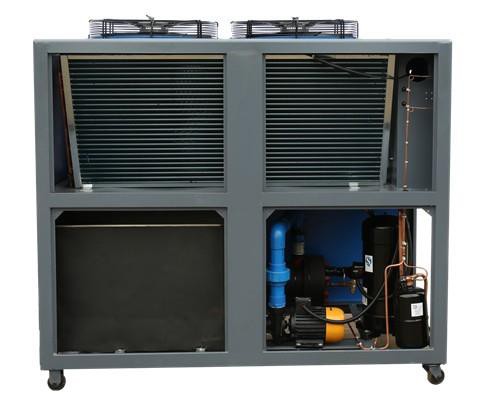
First, let's understand what an air cooled chiller system is. An air cooled chiller is a refrigeration system that uses air to dissipate heat. It typically consists of a compressor, a condenser, an expansion valve, and an evaporator. The basic principle is that the compressor compresses the refrigerant gas, which then releases heat in the condenser and is cooled by the surrounding air. The refrigerant then passes through the expansion valve, where it expands and cools, and finally absorbs heat from the process or space in the evaporator.
The main advantage of air cooled chiller systems is their simplicity and relatively low installation cost. They do not require a separate cooling tower, which makes them suitable for applications where water is scarce or where the installation of a cooling tower is not feasible.
Cooling Function of Air Cooled Chiller Systems
The primary function of an air cooled chiller system is cooling. In industrial applications, air cooled chillers are widely used to cool machinery, such as plastic injection molding machines, extrusion machines, and Special Air Cooler Chiller For Film Blowing Machine. These machines generate a large amount of heat during operation, and if not properly cooled, it can lead to reduced efficiency, poor product quality, and even damage to the equipment.
In commercial and residential buildings, air cooled chillers are used for air - conditioning purposes. They can cool the indoor air by removing heat and humidity, creating a comfortable environment for occupants. The chilled water produced by the chiller is circulated through a network of pipes to air - handling units, which then distribute the cooled air throughout the building.
Heating Function of Air Cooled Chiller Systems
While air cooled chiller systems are primarily known for their cooling capabilities, some models can also be used for heating. This is achieved through a technology called a heat pump. A heat pump is a device that can reverse the refrigeration cycle, allowing the chiller to absorb heat from the outside air (even in cold weather) and transfer it indoors.
In a heat pump - enabled air cooled chiller system, when the heating mode is activated, the compressor changes the flow direction of the refrigerant. The evaporator acts as a condenser, releasing heat into the indoor space, while the condenser acts as an evaporator, absorbing heat from the outside air. This process allows the chiller to provide heating even when the outdoor temperature is relatively low.

However, it's important to note that the heating efficiency of an air cooled chiller system decreases as the outdoor temperature drops. In extremely cold climates, the system may not be able to provide sufficient heating, and additional heating sources may be required.
Advantages of Using Air Cooled Chiller Systems for Both Heating and Cooling
- Cost - effective: By using a single system for both heating and cooling, customers can save on equipment purchase and installation costs. There is no need to install separate heating and cooling systems, which can significantly reduce the overall investment.
- Space - saving: Since only one system is required, less space is needed for equipment installation. This is particularly beneficial for facilities with limited space.
- Ease of maintenance: Having a single system also simplifies maintenance. Technicians only need to be familiar with one type of equipment, reducing the complexity and cost of maintenance.
Limitations of Using Air Cooled Chiller Systems for Both Heating and Cooling
- Temperature limitations: As mentioned earlier, the heating efficiency of air cooled chiller systems decreases in cold weather. In regions with very low winter temperatures, the system may not be able to meet the heating demand.
- Higher energy consumption in heating mode: In some cases, the energy consumption of the chiller in heating mode may be higher compared to dedicated heating systems. This is because the system has to work harder to extract heat from the cold outside air.
Applications of Dual - Function Air Cooled Chiller Systems
- Commercial buildings: Many commercial buildings, such as offices, hotels, and shopping malls, can benefit from air cooled chiller systems that provide both heating and cooling. These buildings have varying heating and cooling requirements throughout the year, and a dual - function system can effectively meet these needs.
- Industrial facilities: Some industrial processes require both heating and cooling at different stages. For example, in the food and beverage industry, certain production processes may need cooling during the manufacturing process and heating for sterilization or drying. Special Chiller Pet Blowing Bottle Machine and other industrial equipment can also benefit from such a system.
Our Company's Offerings
As a leading supplier of air cooled chiller systems, we offer a wide range of products, including Industrial Air Cooled Chiller that can be configured for both heating and cooling. Our chillers are designed with advanced technology and high - quality components to ensure reliable performance and energy efficiency.
We have a team of experienced engineers who can provide customized solutions based on your specific requirements. Whether you need a small - scale system for a laboratory or a large - scale system for an industrial plant, we can design and install the right air cooled chiller system for you.
Contact Us for Purchase and Negotiation
If you are interested in our air cooled chiller systems and want to learn more about their heating and cooling capabilities, or if you have specific requirements for your project, please feel free to contact us. Our sales team is ready to provide you with detailed product information, quotes, and technical support. We look forward to working with you to find the best cooling and heating solutions for your needs.
References
ASHRAE Handbook - HVAC Systems and Equipment. American Society of Heating, Refrigerating and Air - Conditioning Engineers.
Kreider, J. F., & Rabl, A. (1994). Thermal Environmental Engineering. McGraw - Hill.