

As a seasoned supplier of water cooling chillers, I've witnessed firsthand the diverse needs of industries and facilities when it comes to temperature control. Water cooling chillers play a crucial role in various sectors, from manufacturing plants to commercial buildings, ensuring optimal operating conditions and efficient processes. In this blog, I'll delve into the different types of water cooling chillers available in the market, their features, and applications.
Air-Cooled Water Chillers
Air-cooled water chillers are a popular choice for many applications due to their simplicity and ease of installation. These chillers use air to dissipate heat from the refrigerant, eliminating the need for a separate cooling tower or water source. The basic components of an air-cooled chiller include a compressor, condenser, evaporator, and expansion valve.
The compressor is responsible for compressing the refrigerant gas, raising its temperature and pressure. The high-pressure gas then flows into the condenser, where it releases heat to the surrounding air through a series of finned tubes. As the refrigerant cools, it condenses into a liquid and flows through the expansion valve, which reduces its pressure and temperature. The low-pressure liquid then enters the evaporator, where it absorbs heat from the water being cooled, causing it to evaporate back into a gas. The cycle then repeats.

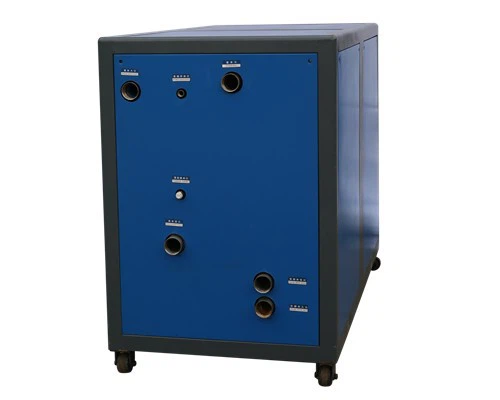
One of the main advantages of air-cooled water chillers is their compact design, making them suitable for applications where space is limited. They also require less maintenance compared to water-cooled chillers since there is no need to maintain a cooling tower or water treatment system. However, air-cooled chillers are generally less energy-efficient than water-cooled chillers, especially in hot climates, as the efficiency of the condenser decreases as the ambient air temperature rises.
Air-cooled water chillers are commonly used in small to medium-sized commercial buildings, such as offices, restaurants, and retail stores, as well as in industrial applications where the cooling load is relatively low.
Water-Cooled Water Chillers
Water-cooled water chillers, on the other hand, use water as the cooling medium to dissipate heat from the refrigerant. These chillers are more energy-efficient than air-cooled chillers, especially in large-scale applications, as water has a higher heat capacity than air, allowing for more effective heat transfer.
The basic components of a water-cooled chiller are similar to those of an air-cooled chiller, but with the addition of a cooling tower. The cooling tower is used to cool the water that is circulated through the condenser of the chiller. The hot water from the condenser is pumped to the top of the cooling tower, where it is sprayed over a series of fill materials. As the water falls through the fill, it comes into contact with the air, which cools it down. The cooled water then flows back to the condenser to repeat the cycle.
Water-cooled water chillers offer several advantages over air-cooled chillers. They are more energy-efficient, especially in hot climates, as the cooling tower can maintain a lower condenser temperature, improving the overall efficiency of the chiller. They also have a longer lifespan and require less maintenance compared to air-cooled chillers, as the water in the cooling tower can be treated to prevent corrosion and scale buildup.
However, water-cooled chillers require a larger footprint and more complex installation compared to air-cooled chillers. They also require a reliable water source and a water treatment system to prevent the growth of bacteria and algae in the cooling tower.
Water-cooled water chillers are commonly used in large commercial buildings, such as hospitals, hotels, and data centers, as well as in industrial applications where the cooling load is high. For more information on Water Cooled Water Chiller, you can visit our website.
Absorption Chillers
Absorption chillers are a type of water cooling chiller that uses a heat source, such as steam, hot water, or natural gas, to drive the refrigeration cycle. Unlike compression chillers, which use a compressor to compress the refrigerant gas, absorption chillers use a solution of a refrigerant and an absorbent to create a refrigeration effect.
The basic components of an absorption chiller include a generator, absorber, condenser, evaporator, and a solution pump. The generator is heated by the heat source, causing the refrigerant to evaporate from the absorbent solution. The refrigerant vapor then flows to the condenser, where it releases heat to the cooling water and condenses into a liquid. The liquid refrigerant then flows through the expansion valve and into the evaporator, where it absorbs heat from the water being cooled, causing it to evaporate back into a gas.
The refrigerant vapor then flows to the absorber, where it is absorbed by the absorbent solution. The solution pump then pumps the diluted absorbent solution back to the generator to repeat the cycle.
One of the main advantages of absorption chillers is their ability to use waste heat or renewable energy sources, such as solar thermal energy, to drive the refrigeration cycle, making them a more environmentally friendly option compared to compression chillers. They also have a lower noise level and require less maintenance compared to compression chillers.
However, absorption chillers are generally less efficient than compression chillers, especially in applications where the cooling load is high. They also require a larger footprint and more complex installation compared to compression chillers.
Absorption chillers are commonly used in applications where there is a readily available heat source, such as in industrial processes, district cooling systems, and large commercial buildings. For more details on a Water Cooled Refrigeration System, which can be related to absorption chillers in some setups, you can explore our website.
Screw Chillers
Screw chillers are a type of compression chiller that uses two interlocking helical rotors, or screws, to compress the refrigerant gas. The screws rotate in opposite directions, drawing the refrigerant gas into the compressor and compressing it as it moves along the length of the screws.
Screw chillers offer several advantages over other types of compression chillers. They have a high efficiency, especially at part-load conditions, as the screws can be adjusted to match the cooling load. They also have a smooth and quiet operation, as the screws provide a continuous compression process without the pulsations associated with reciprocating compressors.
Screw chillers are commonly used in medium to large-scale commercial and industrial applications, such as in hospitals, hotels, and manufacturing plants. For energy-efficient options, check out our Energy Saving Industrial Water Cooled Chiller.
Centrifugal Chillers
Centrifugal chillers are another type of compression chiller that uses a centrifugal compressor to compress the refrigerant gas. The centrifugal compressor consists of an impeller that rotates at high speed, drawing the refrigerant gas into the center of the impeller and accelerating it radially outward. The high-velocity gas then enters a diffuser, where its velocity is reduced and its pressure is increased.
Centrifugal chillers are known for their high efficiency, especially at full-load conditions. They are also capable of handling large cooling loads, making them suitable for large commercial and industrial applications, such as in data centers, airports, and convention centers.
However, centrifugal chillers are more complex and expensive than other types of chillers, and they require a higher level of maintenance. They are also sensitive to changes in the operating conditions, such as the refrigerant flow rate and the condenser temperature.
Conclusion
In conclusion, there are several types of water cooling chillers available in the market, each with its own unique features and applications. When choosing a water cooling chiller, it's important to consider factors such as the cooling load, the ambient temperature, the available space, and the energy efficiency requirements.
As a water cooling chiller supplier, we offer a wide range of chillers to meet the diverse needs of our customers. Whether you need an air-cooled chiller for a small commercial building or a water-cooled chiller for a large industrial plant, we have the expertise and the products to provide you with the best solution.
If you're interested in learning more about our water cooling chillers or would like to discuss your specific requirements, please don't hesitate to contact us. Our team of experts will be happy to assist you in selecting the right chiller for your application and provide you with a competitive quote.
References
- ASHRAE Handbook of Refrigeration. American Society of Heating, Refrigerating and Air-Conditioning Engineers.
- Refrigeration and Air Conditioning Technology. William C. Whitman, William M. Johnson, John Tomczyk, and Eugene Silberstein.