

Hey there! As a supplier of 10 Ton Chillers, I often get asked about how much power these chillers consume. It's a crucial question, especially for businesses looking to manage their energy costs and make informed decisions about their cooling systems. So, let's dive right in and break down the power consumption of a 10 Ton Chiller.
First off, what exactly is a "ton" when it comes to chillers? In the world of HVAC (Heating, Ventilation, and Air Conditioning), a ton of refrigeration is a unit of power. It's defined as the amount of heat required to melt one ton (2000 pounds) of ice at 32°F (0°C) in 24 hours. One ton of refrigeration is equivalent to 12,000 British Thermal Units (BTUs) per hour. So, a 10 Ton Chiller can remove 120,000 BTUs of heat per hour from a space.
Now, onto the power consumption. The power consumption of a chiller depends on several factors, including its efficiency, the type of compressor it uses, and the operating conditions. Let's start with the efficiency, which is often measured by the Energy Efficiency Ratio (EER) or the Coefficient of Performance (COP).
The EER is the ratio of the cooling capacity (in BTUs per hour) to the power input (in watts). For example, if a chiller has an EER of 10, it means that for every watt of power it consumes, it can remove 10 BTUs of heat per hour. The COP, on the other hand, is the ratio of the cooling capacity to the power input, but it's a more comprehensive measure that takes into account the heat rejection and other factors. A higher EER or COP means the chiller is more efficient and will consume less power.

Most modern 10 Ton Chillers have an EER ranging from 10 to 14, which means they consume between 8,571 and 12,000 watts of power to provide 120,000 BTUs of cooling per hour. To put it in more practical terms, if you run a 10 Ton Chiller with an EER of 12 for 24 hours a day, it will consume approximately 288 kilowatt-hours (kWh) of electricity per day. At an average electricity rate of $0.12 per kWh, that's about $34.56 per day or over $12,600 per year.
The type of compressor also plays a significant role in the power consumption of a chiller. There are several types of compressors used in chillers, including reciprocating, rotary screw, and scroll compressors. Scroll compressors are known for their high efficiency and reliability, making them a popular choice for many 10 Ton Chillers. If you're interested in a scroll-type compressor chiller, check out our 12HP 30KW Scroll-Type Compressor Industrial Air Cooled Chiller.
Another factor that affects power consumption is the operating conditions. Chillers are designed to operate at specific temperature and humidity levels, and if these conditions deviate from the design specifications, the chiller may have to work harder and consume more power. For example, if the ambient temperature is higher than the design temperature, the chiller will have to reject more heat, which requires more energy. Similarly, if the load on the chiller (the amount of heat it needs to remove) is higher than expected, the chiller will consume more power.
In addition to the compressor, other components of the chiller, such as the condenser fan, evaporator pump, and controls, also consume power. However, the compressor is usually the biggest power consumer, accounting for about 60% to 80% of the total power consumption of the chiller.
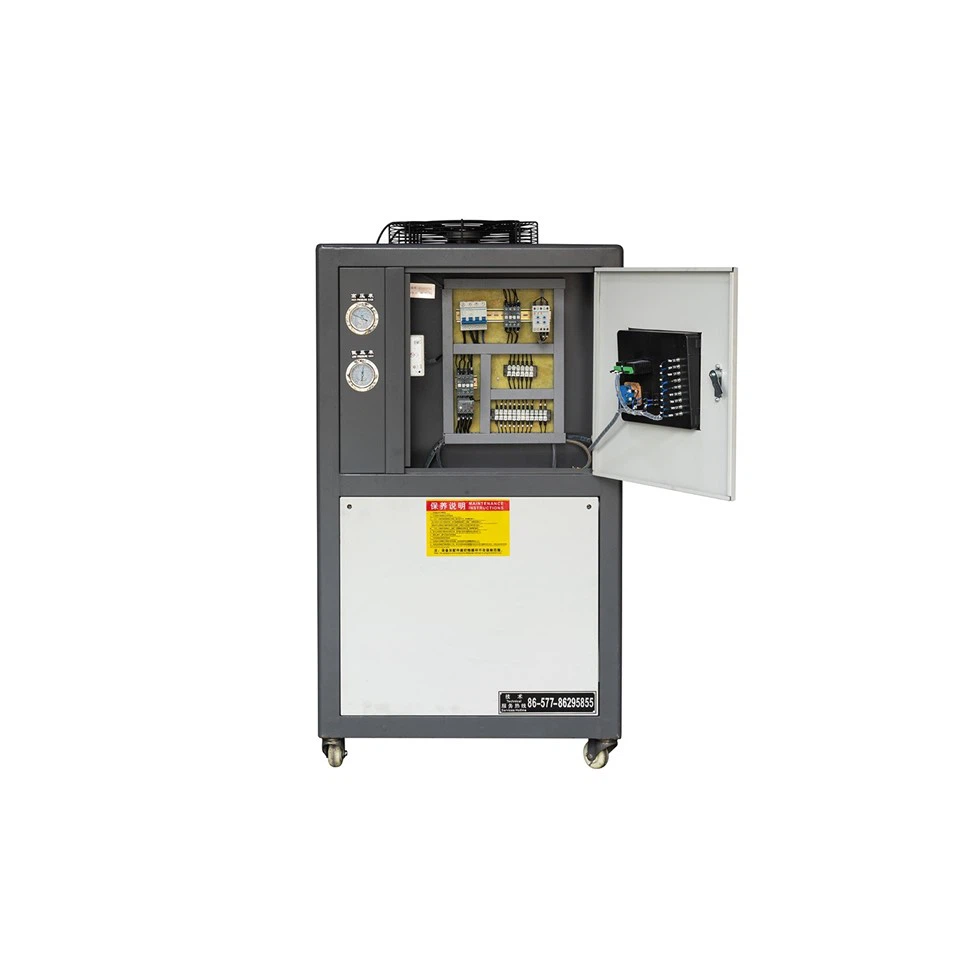
To reduce the power consumption of a 10 Ton Chiller, there are several things you can do. First, choose a chiller with a high EER or COP. This may cost a little more upfront, but it will save you money in the long run by reducing your energy bills. Second, make sure the chiller is properly sized for your application. An oversized chiller will consume more power than necessary, while an undersized chiller may not be able to meet your cooling needs. Third, maintain the chiller regularly to ensure it operates at peak efficiency. This includes cleaning the condenser and evaporator coils, checking the refrigerant levels, and lubricating the moving parts.
If you're looking for a reliable and energy-efficient 10 Ton Chiller, we have a wide range of options to choose from. Our Air Cooled Glycol Chiller is a great choice for applications where you need to cool a glycol solution, while our Water Chiller System Air Cooled Chiller is ideal for cooling water in industrial processes.
In conclusion, the power consumption of a 10 Ton Chiller depends on several factors, including its efficiency, the type of compressor, and the operating conditions. By choosing a high-efficiency chiller, properly sizing it for your application, and maintaining it regularly, you can reduce its power consumption and save money on your energy bills. If you have any questions or need help choosing the right chiller for your needs, don't hesitate to reach out. We're here to help you make the best decision for your business.

References:

- ASHRAE Handbook - HVAC Systems and Equipment
- Carrier HVAC Technical Manuals
- Trane Chiller Product Literature