

As a supplier of screw compressor chillers, I often encounter inquiries about the capacity range of these machines. Understanding the capacity range is crucial for customers as it directly impacts the chiller's ability to meet specific cooling requirements in various applications, from small commercial spaces to large industrial facilities. In this blog, I will delve into the details of the capacity range of screw compressor chillers, exploring the factors that influence it and how to choose the right capacity for your needs.
Understanding the Basics of Screw Compressor Chillers
Before we discuss the capacity range, let's briefly understand how screw compressor chillers work. Screw compressors are positive displacement compressors that use two meshing helical rotors to compress refrigerant gas. This compression process raises the temperature and pressure of the refrigerant, which is then used to transfer heat from the chilled water circuit to the condenser. The cooled refrigerant is then expanded and circulated back to the evaporator to absorb more heat.
The efficiency and performance of screw compressor chillers make them a popular choice for a wide range of applications, including air conditioning in commercial buildings, process cooling in industrial settings, and refrigeration in cold storage facilities.
Capacity Range of Screw Compressor Chillers
The capacity of a screw compressor chiller is typically measured in tons of refrigeration (TR). One ton of refrigeration is equivalent to the amount of heat required to melt one ton of ice in 24 hours, which is approximately 12,000 British Thermal Units (BTUs) per hour.
The capacity range of screw compressor chillers can vary significantly depending on the design, size, and application of the chiller. Generally, screw compressor chillers can have capacities ranging from as low as 20 tons to as high as 1,500 tons or more.
- Low-Capacity Screw Compressor Chillers (20 - 100 Tons): These chillers are suitable for small to medium-sized commercial applications, such as restaurants, small offices, and retail stores. They are often used for air conditioning purposes and can provide efficient cooling in relatively confined spaces. For example, a 100 Ton Air Cooled Chiller can be an ideal choice for a medium-sized office building with a limited floor area.
- Medium-Capacity Screw Compressor Chillers (100 - 500 Tons): Medium-capacity chillers are commonly used in larger commercial buildings, such as hotels, hospitals, and shopping malls. They can also be used for process cooling in light industrial applications. These chillers offer a good balance between performance and cost, making them a popular choice for many businesses.
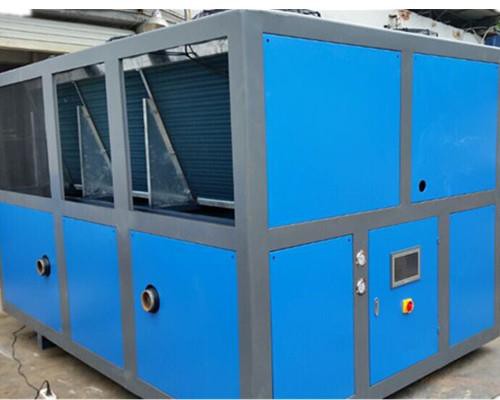
- High-Capacity Screw Compressor Chillers (500+ Tons): High-capacity screw compressor chillers are designed for large industrial facilities, such as manufacturing plants, power generation stations, and data centers. These chillers are capable of providing significant amounts of cooling to meet the demanding requirements of industrial processes. For instance, our High Capacity Industrial Screw Type Air Cooled Chiller For Commercial Used (MG - 160AS) is a powerful chiller that can handle large-scale cooling needs.
Factors Influencing the Capacity Range
Several factors can influence the capacity range of screw compressor chillers. These factors should be carefully considered when selecting a chiller to ensure that it can meet the specific cooling requirements of your application.
- Cooling Load: The cooling load is the amount of heat that needs to be removed from a space or process to maintain the desired temperature. It is determined by factors such as the size of the space, the number of occupants, the type of equipment in use, and the outdoor climate. A higher cooling load will require a chiller with a larger capacity.
- Ambient Conditions: The ambient temperature and humidity can affect the performance of a chiller. In hot and humid climates, the chiller may need to work harder to remove heat, which can reduce its efficiency and capacity. Therefore, it is important to select a chiller that is designed to operate effectively in the specific ambient conditions of your location.
- Refrigerant Type: Different refrigerants have different thermodynamic properties, which can affect the capacity and efficiency of a chiller. For example, some refrigerants have a higher cooling capacity per unit volume than others, allowing the chiller to achieve a higher capacity with a smaller compressor.
- Compressor Design: The design of the screw compressor, including the number of rotors, the size of the rotors, and the compression ratio, can also influence the capacity of the chiller. A well-designed compressor can provide a higher capacity and better efficiency.
Choosing the Right Capacity
Choosing the right capacity of a screw compressor chiller is essential to ensure optimal performance and energy efficiency. Here are some steps to help you select the appropriate capacity for your application:
- Calculate the Cooling Load: Determine the cooling load of your space or process by considering the factors mentioned above. You can use online calculators or consult with a professional HVAC engineer to accurately calculate the cooling load.
- Consider Future Expansion: If you anticipate future growth or changes in your cooling requirements, it is advisable to choose a chiller with a slightly larger capacity than your current needs. This will allow for future expansion without the need for a complete chiller replacement.
- Evaluate Energy Efficiency: Look for chillers with high energy efficiency ratings, such as the Energy Efficiency Ratio (EER) or the Coefficient of Performance (COP). A more energy-efficient chiller can help reduce operating costs over the long term.
- Consult with a Supplier: As a screw compressor chiller supplier, I have extensive experience in helping customers select the right chiller for their needs. I can provide you with detailed information about the capacity range, performance, and features of different chillers, and help you make an informed decision.
The Refrigeration Cycle of Screw Air Cooled Chillers
To better understand how screw compressor chillers work, it is important to know about the refrigeration cycle. The Screw Air Cooled Chiller Refrigeration Cycle involves four main components: the compressor, the condenser, the expansion valve, and the evaporator.
- Compressor: The compressor is the heart of the chiller. It compresses the low-pressure refrigerant gas into a high-pressure, high-temperature gas.
- Condenser: The high-pressure refrigerant gas flows into the condenser, where it releases heat to the surrounding air or water. As a result, the refrigerant condenses into a high-pressure liquid.
- Expansion Valve: The high-pressure liquid refrigerant passes through the expansion valve, which reduces its pressure and temperature. This causes the refrigerant to expand and turn into a low-pressure, low-temperature mixture of liquid and vapor.
- Evaporator: The low-pressure refrigerant mixture enters the evaporator, where it absorbs heat from the chilled water or air. This process cools the water or air, and the refrigerant vaporizes back into a low-pressure gas, which is then returned to the compressor to complete the cycle.
Contact Us for Screw Compressor Chillers
If you are in the market for a screw compressor chiller, I encourage you to contact us to discuss your specific requirements. As a trusted supplier, we offer a wide range of screw compressor chillers with different capacity ranges to meet the diverse needs of our customers. Our team of experts can provide you with personalized advice and support to help you select the right chiller for your application. We also offer installation, maintenance, and repair services to ensure that your chiller operates smoothly and efficiently.
Don't hesitate to reach out to us for more information and to start the procurement process. We look forward to working with you to provide the best cooling solutions for your business.
References
- ASHRAE Handbook - Refrigeration. American Society of Heating, Refrigerating and Air-Conditioning Engineers.
- HVAC Systems Design Handbook. McGraw-Hill Professional.